19th February 2019
Akaroa is a picturesque seaside settlement southwest of Christchurch, situated on a stunning peninsula formed from two extinct volcanoes whose craters were gradually flooded by the sea. The small town retains a distinct French influence, having been originally settled by French whalers around the time of the Treaty of Waitangi, though, wisely, they ultimately chose to live under British rule. Today, Akaroa’s economy relies primarily on tourism, with some fishing. While Lyttelton has traditionally been the main port of call for cruise ships visiting this part of the South Island, the earthquake that devastated Christchurch several years ago also severely damaged its harbour, making Akaroa the default stop.
Our journey to the peninsula was marked by the largest number of dolphins Sue and I have ever seen at one time. On the day before our arrival, we were playing Scrabble in the observation lounge high up on Deck 14 when we noticed a pod of around ten dolphins swimming and leaping in front of the bow of the Columbus. Moments later, we saw numerous more pods racing in from all directions, seemingly eager to leap in front of our ship. There had to be over a hundred, all intent on passing beneath us, a truly spectacular sight. Sue was concerned they might be caught in the ship’s propellers, but we later learned during our evening meal that they had continued to provide entertainment for those sunbathing at the stern.
While waiting for our tender transfer to the small port of Akaroa, I amused myself by watching Hector’s dolphins swim around the ship. These are the smallest and some of the rarest of all dolphins.
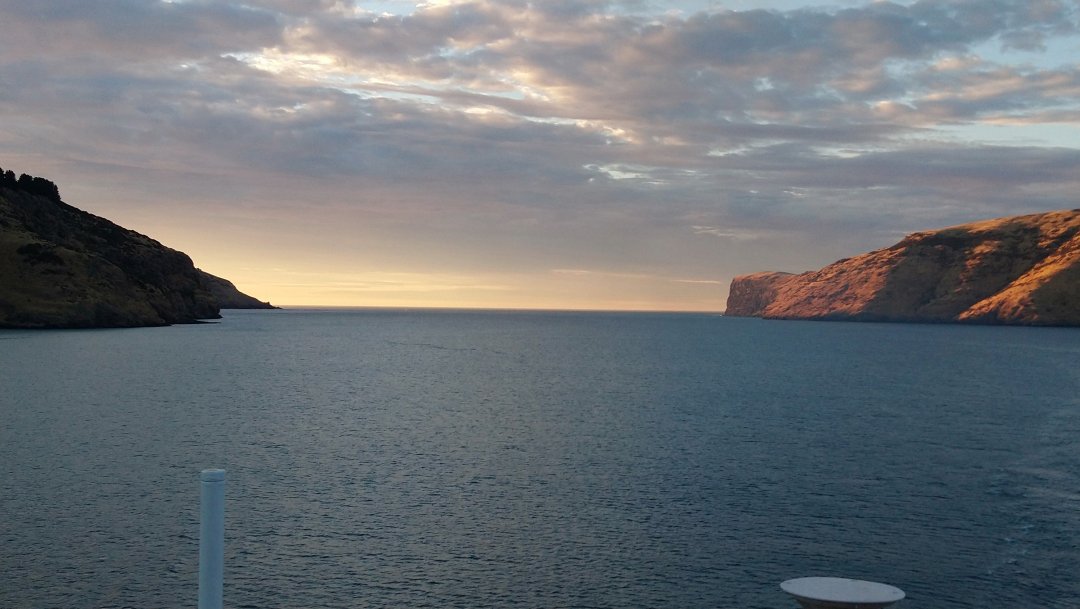
The transfer took around 15 minutes across a tranquil bay, sheltered from the open ocean by the surrounding volcanic landscape, a beautiful way to approach the settlement. The Columbus looked tiny against the dramatic backdrop of mountains and volcanic plugs.
After disembarking, we strolled into town, stopping first at the small wooden Methodist church to enjoy the cool interior and admire its stained-glass windows. A little later, we entered the Catholic church but didn’t explore further, as the priest was preparing for noon mass, so we left him to his preparations.

The Akaroa Museum was our next stop, and what a gem it proved to be. After watching a fascinating and informative video on the history of the settlement, we spent time exploring the many artefacts and displays. It’s an absolute must-visit for anyone new to the area.
We had planned to do two walks during our port stop, so after leaving the museum, we made our way through the town to the shore, following a path leading to Children’s Bay. This sandy strip was rather spoiled by swathes of dark brown seaweed washed up along the shoreline, not at all suitable for children’s bathing, which perhaps explained why the only visitor was a woman with her dog.
From here, our path began to wind its way upwards into the hills. It was midday and hot, and after a few hundred metres, Sue decided to turn back, seeking the shade of some trees at sea level while I pressed on to the top, hoping to capture a panoramic photo of the bay. Unfortunately, I was disappointed to find the summit covered in dense forest, obscuring any view beyond the trees. Returning to Sue, we retraced our steps back into town.

Finding a restaurant with a pretty garden, we stopped for some refreshments. I tried a beer called Red and was so impressed that I ordered a second. Meanwhile, Sue took the opportunity to browse the shops along the main street. Knowing she would be a while, I took my time, sipping Akaroa’s finest craft ale and indulging in a spot of people-watching.
Joining up again, we made our way through the shops, passing the pier where our tenders were steadily ferrying fellow cruisers to and from the ship. Continuing, we headed towards the lighthouse on the outskirts of the settlement. It had been relocated to this site several decades earlier after being replaced by a more modern version.
From here, we visited the nearby Garden of Tane, a largely wooded area with steep paths winding up into the hillside. As the heat of the day began to take its toll on Sue, she decided to return to the pier, while I explored the garden further, taking in the viewpoint. I also made a brief visit to the adjacent Catholic cemetery, where I couldn’t help but admire the thoughtfulness of its design. Part of the forest had been cleared to provide the graves’ occupants with a spectacular view over the bay. Now that’s thoughtful with such attention to detail!

Finding Sue happily munching on a huge ice cream, we caught the next tender back to the ship, where I indulged in a double beef burger with cheese. That’s becoming a bit of a bad habit, one that will have to stop when we get home! Perhaps.

Akaroa is a sleepy town set amidst beautifully soft volcanic scenery, no harsh lines or bubbling cauldrons here. Thermal activity subsided long ago, and nature has gradually softened the once-aggressive forces of the earth’s core, though the occasional earthquake still serves as a reminder of its volatile past. Seismologists predict that a major one is due any year now.
Access by road from other parts of New Zealand doesn’t seem particularly straightforward, with long, winding routes and few settlements along the way. The car park contained a fair number of RVs, and we spotted a couple of small but somewhat dated hotels. There have been plans in the past to extend the railway to Akaroa, but until that happens, it seems the cruise ships are keeping the town viable. It’s a wonderful place to relax, so long as the ground beneath your feet behaves itself!


Leave a Reply